AI Advancements: Are We Overhyping Progress?
As AI technology continues to evolve, it's easy to get swept up in the excitement. However, we must distinguish between genuine progress and mere hype to understand the true impact of AI on various industries.

Suman Basnet
September 5, 2026
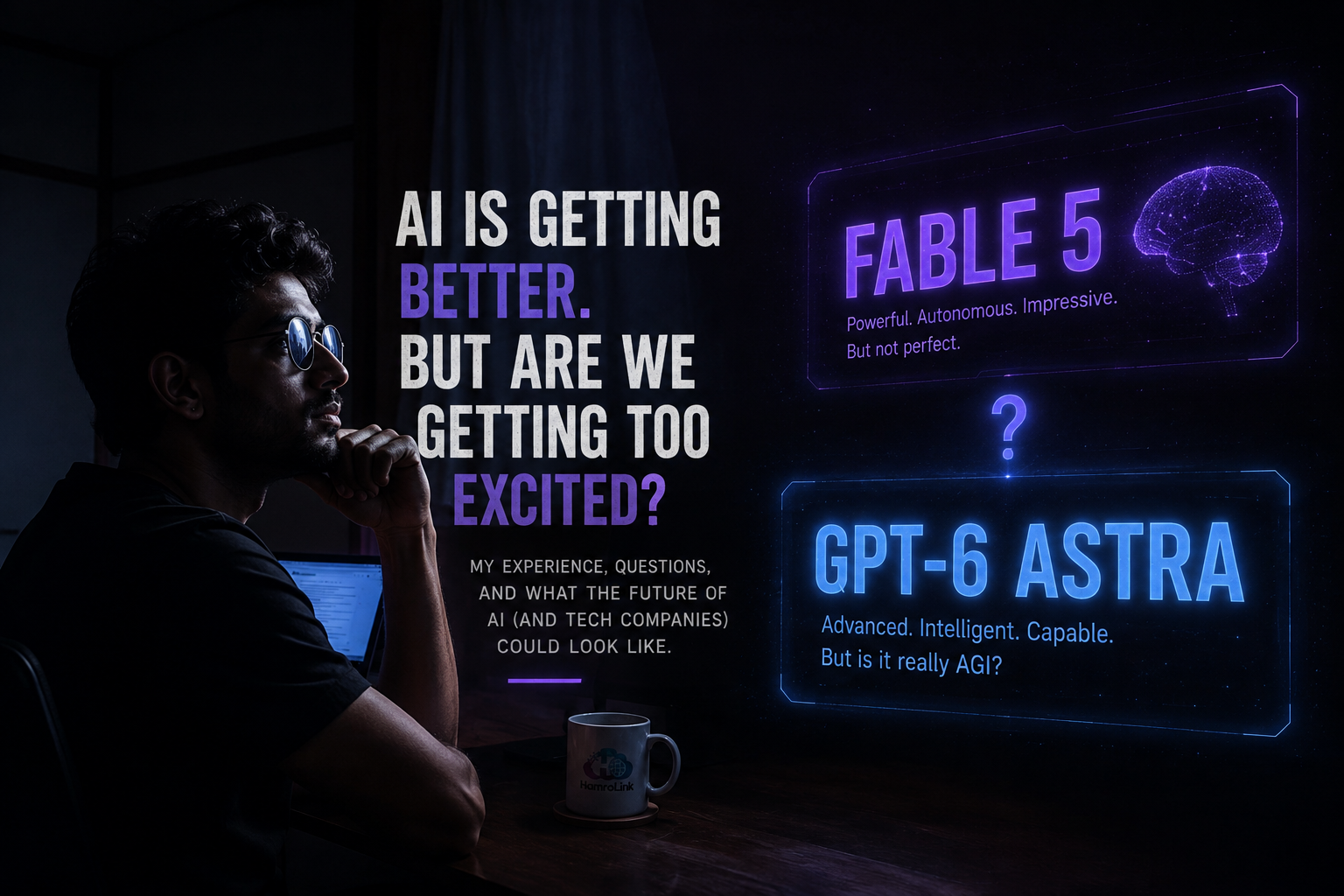
AI Is Getting Better. But Are We Getting Too Excited?
Every time a major AI model is released, the internet seems to go through the same cycle.
A new model arrives. The benchmarks look incredible. Someone posts a demo doing something that previously took a professional hours. Then the headlines begin:
“AGI is here.”
“Software engineers are finished.”
“Video editors are dead.”
“Everyone who works on a computer needs to find another career.”
I understand why people react this way. The models really are getting much better.
But after using several of these supposedly revolutionary models myself, I have started to question how much of what we see is actual progress and how much is marketing, demos, and expectations getting ahead of reality.
The Difference Between a Demo and Real Work
One thing I have noticed repeatedly is the difference between “AI can do this” and “AI can reliably do this.” Those are completely different statements.
A model might create an impressive video once. That doesn't mean it can consistently create the exact video you need.
I experienced this myself recently. I tried using a new AI video model that had been getting a lot of attention online. Before trying it, I had already seen many people talking about how AI video editing was basically solved and how video editors would soon become unnecessary.
So I tried making a relatively simple video. I retried it almost 20 times. The results were sometimes interesting. Some generations looked impressive. But I couldn't consistently get the output I actually wanted.
That experience made me think: If I have to generate something 20 times, inspect the results, explain the problem again, change the prompt, regenerate, and repeat, has AI really replaced the video editor? Or has it simply become another tool the video editor uses? That distinction matters.
Capability is Not Reliability
I think we often mix three different things together:
- Capability: AI can perform the task.
- Reliability: AI can perform the task correctly most of the time.
- Autonomy: AI can perform the task correctly without constant human supervision.
A model demonstrating the first does not automatically mean we have achieved the other two. This is especially important for business.
A business owner doesn't really care whether an AI model can create a website in a demo. They care whether it can create the website correctly, connect the necessary systems, understand their business, handle edge cases, maintain it, fix problems, and keep doing the job next month without them constantly checking everything. That is a much harder problem.
What Happens When AI Becomes Genuinely Autonomous?
This is where my thinking gets more interesting. I am not particularly scared of AI because I think advanced AI automatically equals a good business. It doesn't.
A smarter model doesn't automatically understand customers, distribution, pricing, culture, regulations, operations or strategy. A business can have access to the most advanced model in the world and still fail because it has a bad product or doesn't understand its market.
But I do think AI could fundamentally change the technology industry. Imagine a normal small business being able to build its own internal CRM, website, dashboard, inventory system, and automation using AI. Then add open-source models, local inference, open-source databases, workflow automation, and cheap computing.
At some point, the business might ask:
“Why do I need to pay for all these separate software products?”
That is a much bigger question than whether AI replaces programmers.
Software Could Become Abundant
Historically, software was expensive to produce. You needed developers, designers, infrastructure, and time. Because of that, businesses bought software from specialized companies.
AI changes the production cost. If AI can build software dramatically faster, the marginal cost of creating a custom internal application could become extremely low. And open-source makes this even more interesting.
A business may not need the smartest AI model available for every task. It might use a small open model for simple work, a larger model for complicated reasoning, and a frontier model only when necessary. In other words, intelligence itself could become increasingly commoditized.
And if intelligence becomes cheap, some software companies will have a problem.
Does This Mean Big AI Companies and SaaS Companies Disappear?
I don't think so. But I think their value proposition will change. Today, many companies sell software. Tomorrow, they may sell systems that actually do the work.
- CRM software becomes an AI sales system.
- Email marketing software becomes an AI marketing system.
- Analytics software becomes an AI business analyst.
- Website builders become AI business operators.
The interface may become less important. The system's ability to understand context, access data, execute actions, and reliably produce outcomes becomes more important. And this is where I think the strongest companies will have an advantage.
Intelligence May Become Cheap, Context Won't
Consider a small grocery store. An AI model can write a product description. That's easy. But knowing which products sell in that particular neighborhood, which customers prefer cash on delivery, whether free delivery makes financial sense, when to send an offer, which payment method customers actually use, and whether the owner should spend money on advertising requires business context.
The AI model itself doesn't automatically have that context. The company that owns the business data, workflows, integrations, customer relationships, and distribution may be more valuable than the company that simply provides the smartest model.
This is one reason I don't think advanced AI automatically destroys every technology business. It may destroy generic technology. That's different.
And Then There Is the Hype
This is probably the part I find most interesting. Whenever a new model comes out, expectations jump much faster than actual reliability. A benchmark improves. A controlled demo looks incredible. A creator makes a video showing what the model can do. Millions of people watch it.
Then the internet turns:
“AI can do this.”
into:
“AI has replaced this entire profession.”
That second statement requires a much higher standard. If an AI can occasionally perform a task, that's useful. If it can perform the task reliably, that's transformative. If it can perform the task reliably and autonomously at a lower total cost than a human, that's when an industry really starts changing. We should wait for that third stage before declaring entire professions dead.
Will Millions of Users Make AI Worse?
I also wondered about something else. When millions of people start using a new model, will its performance actually decrease? Usually, the model doesn't suddenly become less intelligent simply because more people are using it. But the experience can change.
Infrastructure has capacity limits. Providers can introduce rate limits, routing, different compute budgets, or different service tiers. They also have to balance quality against latency and inference cost. And that brings up another important issue.
The model's advertised intelligence is not necessarily the same as the intelligence you receive for every request. Companies have to make the economics work. If one model is incredibly expensive to run, it doesn't make sense to use the most expensive configuration for every simple task.
So the future will probably involve a lot of model routing:
- Simple task → cheap model.
- Moderate task → stronger model.
- Complex task → frontier model.
- Computer operation → agent.
The user may not even know which model handled the request.
So What Happens to Technology Companies?
I don't think the answer is “all tech companies die.” I think we are going to see a massive restructuring. Some categories become commodities. Generic SaaS will face pressure. Simple software development becomes cheaper. Basic content production becomes cheaper. Low-end outsourcing becomes harder to justify. AI wrappers with no real differentiation become vulnerable.
At the same time, infrastructure, security, payments, identity, data, specialized business systems, distribution, and trusted brands could become even more important. The companies that survive may be the ones that own something difficult to reproduce. That could be data, distribution, a network, a trusted brand, deep industry knowledge, infrastructure, or it could simply be a very good understanding of a specific customer's problem.
What I Actually Believe
I don't think we should ignore the progress happening in AI. But I also don't think we should believe every “AGI is here” headline. The technology can be simultaneously overhyped today and underestimated over the long term.
A model doesn't need to be perfect today to completely change the economics of software over the next few years. And I don't think the biggest question is: “Which company has the smartest AI?” The more interesting question is: “What happens when intelligence becomes cheap enough for almost every company to have access to it?”
Maybe a five-person company will eventually operate with a handful of humans and dozens of AI agents. Maybe a business will build much of its own software instead of subscribing to dozens of SaaS products. Maybe open-source models will handle most everyday tasks while frontier models are reserved for difficult problems. Maybe many of today's software categories will disappear.
But even then, having access to intelligence won't automatically make someone a great entrepreneur. Strategy still matters. Customers still matter. Execution still matters. Distribution still matters. And understanding the real world still matters. AI can become incredibly intelligent. That doesn't mean it automatically knows what business to build. And for now, that distinction is probably more important than the latest benchmark.
Enjoyed this article?
Subscribe to get the latest posts delivered straight to your inbox.