If AI Creates the Internet, Who Teaches the Next AI?
What happens when AI learns from AI-generated content? Explore AI model collapse, synthetic data, original data, and why reality may become the new data moat.

Suman Basnet
September 14, 2026
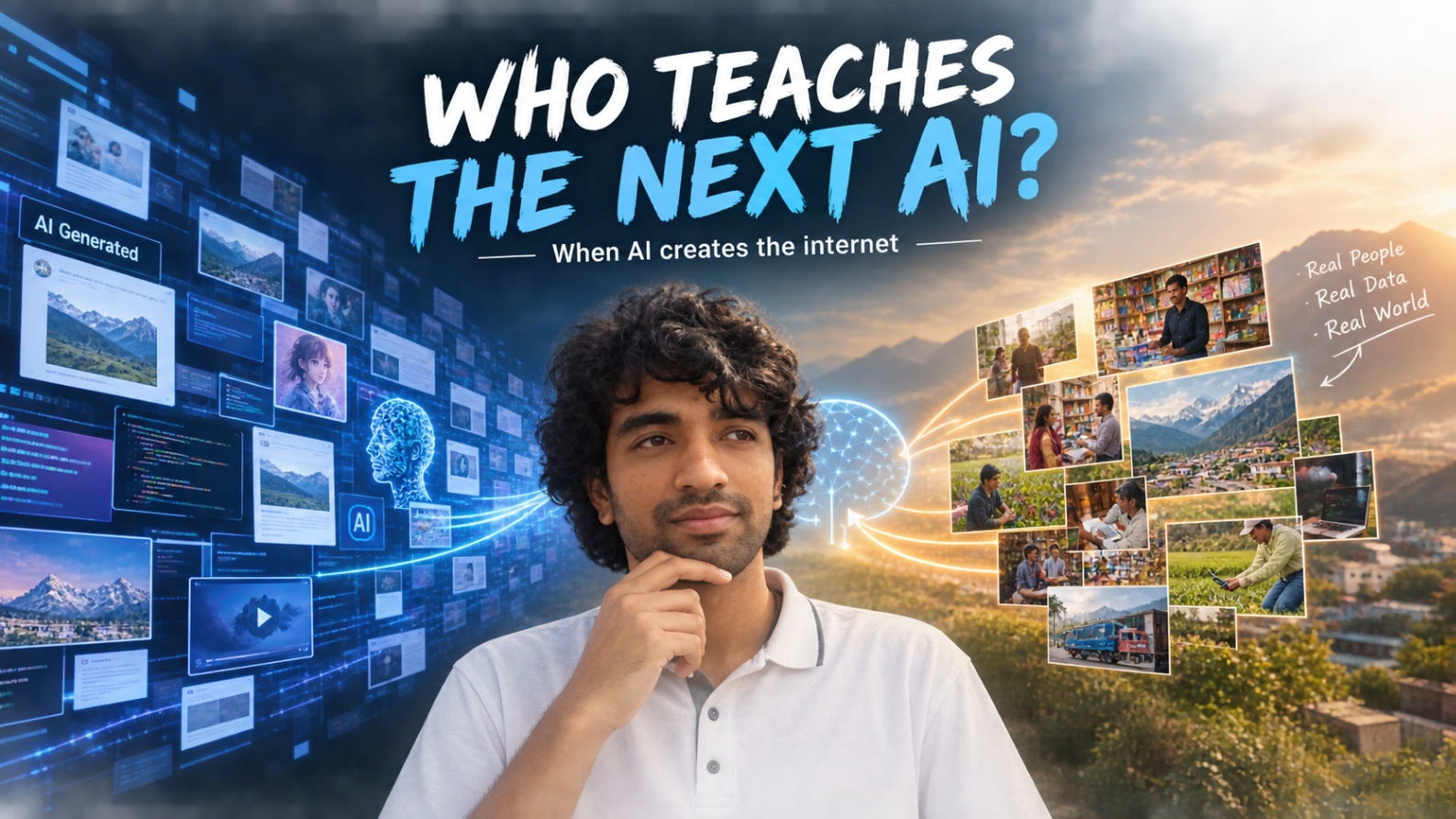
The internet used to be a record of what humans knew. What happens when more and more of it becomes a record of what AI generated?
The internet used to be our memory
For most of the internet's history, the basic loop was pretty simple.
Humans experienced things. Humans learned things. Humans wrote them down. The internet collected all of it. Then AI came along and learned from that enormous collection of human knowledge.
Now the loop is changing.
AI can write articles, generate images, write code, summarize research, answer questions, create videos, and produce millions of pieces of content in a fraction of the time a human would need.
And much of that content is ending up on the internet.
So I started wondering:
What happens when future AI systems increasingly learn from content produced by previous AI systems?
Not someday in some science-fiction future.
It has already started.
The internet is becoming synthetic
We don't have a perfect number for how much of the internet is AI-generated. Anyone giving you a precise percentage should probably explain exactly what they measured.
But the direction is becoming easier to see.
In August 2026, Pew Research Center analyzed 490,000 English-language webpages collected from Common Crawl between January 2021 and July 2026. In its July 2026 sample, 10% of webpages showed significant signs of AI authorship or editing. Among pages published after ChatGPT was released, that figure was more than one-third.
That doesn't mean 10% of the entire internet is fully written by AI. It doesn't even mean those pages were entirely generated by AI. It means there are measurable signs of AI authorship or substantial editing in those pages.
That's already interesting enough.
Because the loop now looks something like this:
Humans
   ↓
Human experiences and knowledge
   ↓
Internet
   ↓
AI training
   ↓
AI-generated content
   ↓
Internet
   ↓
Future AI training
   ↓
More AI-generated content
   ↓
...
And that creates a strange possibility.
The internet could eventually become a place where AI is learning from a growing amount of its own previous output.
So what happens then?
The AI model collapse problem
There is already research that gives us one possible warning.
A 2024 Nature paper studied what happens when models are repeatedly trained on data generated by previous generations of models. The researchers found that indiscriminate recursive training on generated data can cause model collapse: models begin losing information from the original data distribution, with rare or low-probability information disappearing first. ([Nature][2])
Think about a forest.
The original forest has huge trees, tiny plants, strange insects, different animals, dead branches, unusual shapes, and thousands of things you might only see once.
Now imagine making a description of that forest.
Then asking another system to recreate the forest from the description. Then describing that recreation. Then recreating it again.
You might preserve the obvious things:
Trees. Green leaves. Animals. Rocks.
But the strange little details become easier to lose.
Eventually, you're left with something that still looks like a forest.
It just isn't the original forest anymore. That's roughly the intuition behind model collapse.
And this matters because the unusual information may be some of the most valuable information we have.
The weird solution problem
This is where I keep thinking about my own experience building software. Sometimes something doesn't work. You read the documentation. You check the API. You look at the logs. You try the obvious fixes. Nothing.
Then you try something that almost feels stupid. Maybe the request is being processed in a completely different place than you thought. Maybe changing one seemingly unrelated thing changes the entire behavior. Maybe you remove something you thought was necessary.
And suddenly:
It works.
I've had this happen more times than I can count. The interesting part isn't that humans are magically creative. It's that real-world systems constantly give us feedback that wasn't present in the original explanation. The documentation says one thing. The production system does another. The user sends an input you never expected. A weird edge case appears. You investigate it. And sometimes you discover something nobody planned for.
That kind of information is difficult to capture in a clean dataset because the dataset didn't contain the problem until someone encountered it.
Can AI discover those things too?
This is where I don't think the answer is simply, "AI can't think like humans."
That's too easy.
AI systems can already generate unexpected ideas, combine concepts in surprising ways, search through huge numbers of possibilities, and produce solutions humans wouldn't immediately think of.
Future systems may become much better at this.
They could generate thousands of hypotheses, run experiments, test code, evaluate outcomes, and keep the solutions that work.
In fact, that might become one of the most important ways AI improves.
But there's a deeper question underneath it:
Where does the new information come from?
If an AI is mostly learning from previous AI-generated material, it can remix and transform what already exists extremely well.
But if we want it to discover something genuinely new, it eventually needs some way to interact with something outside its existing representation of the world.
That could be a human.
A customer.
A production system.
A scientific experiment.
A robot.
A sensor.
A database it has never seen.
A new environment.
Or simply reality pushing back and saying:
"No. That doesn't work."
The web could split into two layers
This makes me think the future internet could become divided into two very different kinds of information.
The Commodity Web
This is the information AI can produce cheaply and endlessly.
Generic articles. Product descriptions. SEO pages. Summaries. Basic tutorials. AI-generated images. Generic opinions. Rewritten versions of things that already exist.
The supply of this information could become almost unlimited.
And when information becomes almost free to produce, producing more of it doesn't necessarily make it more valuable.
Then there's something else.
The Reality Layer
This is information that comes from actual interaction with the world.
Customer conversations. Production failures. Private business data. Scientific measurements. Experiments. Sensor readings. Original research. Unusual user behavior. Local knowledge. New discoveries. Real-world observations.
The weird bug that only happens under a specific condition. The experiment that failed for a reason nobody expected. The customer who uses a product in a way the designers never imagined. This information is different.
AI can summarize it. AI can analyze it. AI can learn from it. But somebody has to encounter the reality first.
And that distinction could become extremely important.
Maybe the data moat changes
We've spent years talking about companies having a "data moat."
Usually that means:
We have more data than our competitors.
But if AI can generate enormous amounts of synthetic data, volume becomes less impressive.
A million AI-generated product descriptions aren't necessarily more valuable than ten thousand real customer interactions.
A billion generated answers aren't necessarily more valuable than a dataset containing the strange failures nobody else has observed.
So maybe the important distinction isn't:
How much data do you have?
It's:
How much original information do you have access to?
That's a very different question.
Imagine two companies.
Company A has billions of pieces of publicly available AI-generated content.
Company B has five years of private production data, customer behavior, failed experiments, support conversations, transaction patterns, and real-world outcomes.
The second company's dataset might be much smaller. But it could be much harder to reproduce.
That's a different kind of data moat.
AI may have to learn by doing
This is where I think the future gets particularly interesting. Maybe the next phase of AI isn't primarily about finding more text on the internet. Maybe it's about creating better ways for AI to interact with reality.
An AI coding system can write code. But it can also run the code.
A research system can propose a hypothesis. But it can also run an experiment.
An AI business agent can make a recommendation. But it can observe what customers actually do afterward.
A robot can make a prediction. Then it can physically test it.
The important thing is the feedback loop:
AI makes a prediction
        ↓
Reality responds
        ↓
AI observes the result
        ↓
AI updates its understanding
        ↓
AI tries again
That's very different from:
AI generates content
        ↓
Internet stores it
        ↓
Another AI learns from it
        ↓
Another AI generates more content
The first loop creates new information through interaction.
The second mostly recycles information that already exists.
That difference may become increasingly important.
So what happens to human creativity?
This is the part I'm still unsure about.
Maybe humans won't remain important because we're better at producing content.
We're already losing that advantage.
AI can produce more text, images, code and other digital content than any individual human could ever produce.
So perhaps human value moves somewhere else.
Humans experience things. Humans go into the world. Humans notice problems. Humans make strange decisions. Humans run experiments. Humans build things that fail. Humans discover edge cases. Humans ask questions that didn't exist before.
And sometimes humans try something that makes absolutely no sense until it works.
If AI makes the production of information incredibly cheap, then maybe the scarce resource becomes the creation of genuinely new information.
That's a very different future from simply saying, "AI will replace creative people."
But model collapse isn't inevitable
I don't think the conclusion should be:
"AI will eventually train on AI-generated data and collapse."
That's too simple.
The Nature research is specifically about the effects of indiscriminate recursive training on generated data. It doesn't mean every use of synthetic data destroys a model.
AI developers can filter generated content. They can preserve high-quality human data. They can use curated datasets. They can collect proprietary information. They can use human feedback. They can train systems through environments where outcomes can be verified. They can use tools, simulations, experiments and real-world interaction.
So AI may find ways around this problem. In fact, I expect it will.
And that creates an even more interesting question.
If AI eventually becomes capable of generating its own experiments, exploring possibilities, testing hypotheses and discovering new information...
then perhaps AI won't need the internet nearly as much as we think it does today.
It could start generating knowledge through interaction rather than simply consuming knowledge from the web. I don't know if that's where we're heading. But I think that's the more interesting question.
The future may have two kinds of information
One kind is abundant. The other is difficult to produce. The abundant kind is information that can be generated from what already exists. The scarce kind is information that comes from something genuinely new happening in the world. That distinction could affect search.
It could affect AI training. It could affect SaaS. It could affect data businesses. It could affect research. It could even change what we consider valuable human work.
Because if AI can generate ten million reasonable answers to a question, the answer itself may become cheap.
The difficult part may be finding the one question nobody thought to ask. Or discovering the weird result nobody expected. Or collecting the data nobody else has.
So, who teaches the next AI?
Maybe the answer isn't simply humans. Maybe it's:
Humans interacting with reality.
AI will probably generate an enormous amount of the future internet. That's not necessarily a bad thing. The internet could become more useful, more personalized and dramatically cheaper to produce. But I suspect something else will happen at the same time.
The more synthetic information we create, the more valuable genuinely original information becomes. The more AI can generate, the less valuable generic generation becomes. And the more intelligence becomes available as a commodity, the more important it may become to have access to things that intelligence alone cannot simply invent. The most valuable information in the future may not be the information that is easiest to generate. It may be the information that couldn't have been generated without touching reality.
And if that's true, then the ultimate data moat might not be having the biggest database. It might be having access to something nobody else has seen.
Because when intelligence becomes cheap, maybe originality becomes expensive.
Enjoyed this article?
Subscribe to get the latest posts delivered straight to your inbox.